


Link building for lawyers is the work of earning links from relevant websites to your law firm website. These links, called backlinks, help readers discover your firm and give search engines additional context about your pages.
The approach matters. Earning editorial links through useful insight and credible relationships can support visibility; buying links to manipulate rankings can put it at risk.
For a law firm, strong opportunities begin with work that builds credibility: explaining a legal development to a reporter, contributing an article or teaching a bar program. A backlink helps readers explore that expertise.
What Is Link Building?
A backlink is a clickable link from another website to a page on your firm’s site. A publication might link an attorney’s name to their biography, or a bar association might link a speaker listing to the firm’s website. Backlinks are also called inbound links. The websites providing them are referring domains.
Several related terms mean different things. A local citation is a listing of business details, such as the firm’s name, address and phone number; it may include a link. A brand mention names the firm without necessarily linking to it; record coverage and backlinks separately. An internal link connects two pages on your own website.
How Backlinks Shape Visibility in AI Search
Links remain one of several signals in Google’s ranking systems. Google’s ranking systems guide explains that link analysis helps its systems understand pages and judge their usefulness, and Google counts links to a business toward local prominence. Editorial links also send prospective clients and referral sources straight to your firm and build a stronger online reputation.
AI search runs on the same foundation. Google’s guidance on AI features says established SEO practices still apply and inclusion isn’t guaranteed. AI Overviews, ChatGPT and Perplexity tend to cite the same small set of pages for a given question, usually roundup articles, directory pages and news stories. When a prospective client asks for the best employment lawyers in their city, the answer is assembled from those pages. If your firm isn’t named on them, it is unlikely to be named in the answer.
Being quoted and linked by respected outlets puts your attorneys’ expertise into more of the sources these tools summarize. Consider backlinks alongside the credibility signals Google weighs for legal content.
Backlinks for Law Firms: What Makes a Link Worth Earning
One link from a respected publication can be worth more than dozens from low-quality directories. The practical question is what makes that publication, and that particular link, relevant to your firm.
Look at the audience first. Does the website reach people who might hire, refer or professionally evaluate your attorneys?
|
Signal |
A link worth earning |
A link to avoid |
|---|---|---|
|
Relevance |
Legal, practice-area or local connection |
Unrelated subject or audience |
|
Site authority and audience |
Recognizable publisher; real readership |
Site built mainly to sell links |
|
Placement on the page |
Relevant story, resource or biography |
Hidden or unrelated template link |
|
Editorial vs. paid |
Independent choice; paid links qualified |
Payment for ranking credit |
|
Anchor text |
Natural firm name or description |
Forced, repeated keyword phrases |
|
Dofollow / nofollow |
Appropriate attributes; useful audience |
Guaranteed ranking claims based on attributes |
Anchor text is the clickable wording. It should help readers understand the destination. Your firm’s name or the attorney’s name is often more appropriate than a promotional search phrase.
SEO tools offer scores such as domain authority, but these are third-party estimates, not Google metrics. Use them as screening aids alongside editorial standards and audience relevance.
A regular link, often called “dofollow,” needs no special dofollow attribute. Google’s link qualification guidance explains sponsored, nofollow and user-generated links. A nofollow link from a respected outlet can still send readers to your firm. Judge backlinks for law firms by their business purpose as well as their possible search contribution.
Law Firm Link Building Strategies That Work
|
Tactic |
Where the link comes from |
Effort |
|---|---|---|
|
Legal directories and bar listings |
Profiles and member pages |
Low |
|
Expert commentary for journalists |
Independently reported stories |
Medium to high |
|
Bylined and guest articles |
Author bios; relevant references |
High |
|
Speaking, CLE and association programs |
Speaker pages; agendas; recaps |
Medium to high |
|
Community and sponsorship links |
Organization and event pages |
Medium |
|
Unlinked brand mentions |
Existing coverage and profiles |
Low |
|
Content other lawyers cite |
Editorial resource references |
High |
|
Pages AI tools already cite |
Roundups, directory categories, news features |
Medium |
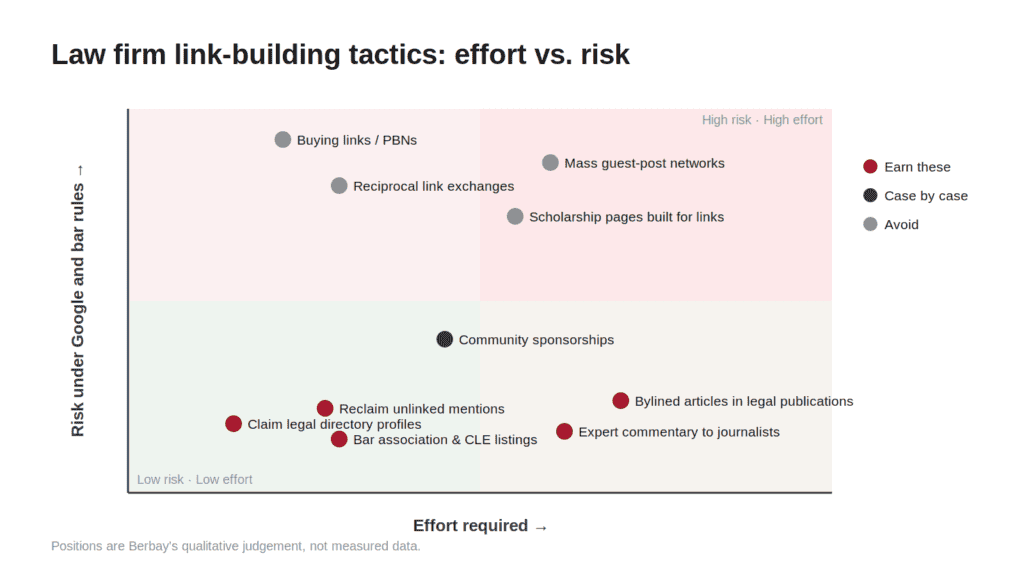
The chart below compares the tactics as a planning guide. Effort increases from left to right and risk increases from bottom to top.
1. Claim the Legal Directories and Bar Listings Worth Having
Begin with your state bar and relevant professional associations, then evaluate established legal directories such as Avvo and Justia. Claim useful free profiles and maintain legitimate recognition-based listings, including Martindale-Hubbell, Super Lawyers and Best Lawyers, where your attorneys qualify. Keep practice areas, credentials, contact details and destination links accurate.
Directories serve different purposes: a basic profile is different from a selection-based recognition. Our guide to the lawyer directories worth your firm’s time explains those distinctions without requiring you to pursue every listing.
Maintain profiles over time. Treat awards and rankings as a separate credibility decision, with accurate descriptions of the recognition earned.
2. Be the Attorney Reporters Call
A reporter needs a source who understands the issue, responds on deadline and explains its significance in plain language. Monitor relevant journalist requests alongside direct outreach. Prepare attorneys to offer a clear observation, relevant background and availability for follow-up. Match expertise to the reporter’s coverage area.
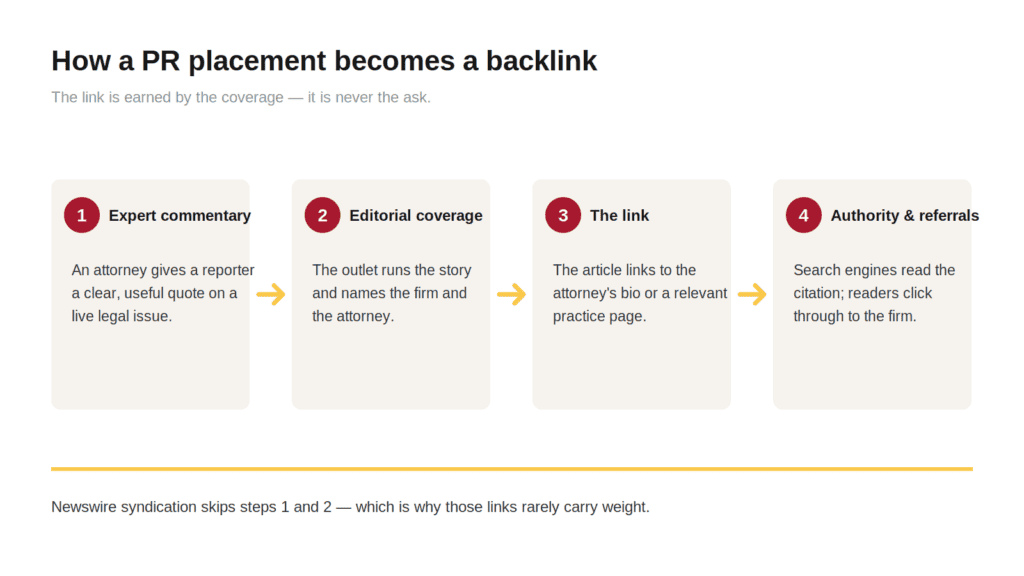
The right press coverage puts your attorneys’ expertise on websites with established audiences and strong editorial standards. When a reporter cites an attorney’s analysis and links to a biography, firm resource or original research, that link gives readers a useful next step. High-authority backlinks begin with a credible publication, a relevant story and a destination worth referencing.
Effective law firm public relations starts with the story. Offer a timely perspective on a legal issue the outlet’s readers care about. Give reporters accurate attorney biographies and direct links to relevant resources. A specific resource often provides a stronger reason to link than a general homepage.
This is how PR and SEO work together: expertise earns attention, coverage introduces the firm to the right audience, and an editorial link connects that audience to your website. Our guide to how to get media coverage explains how to build those opportunities.
Berbay in practice: earning coverage while respecting a client’s limits
In a high-profile litigation media campaign, a Los Angeles law firm’s client wanted attention for his lawsuit but declined interviews and photographs. Berbay prepared a statement, contacted local and national media, and managed requests around those boundaries.
The campaign secured dozens of placements, including The New York Times, The Washington Post, Los Angeles Times, Associated Press and Reuters. Berbay identified a newsworthy story and gave reporters material they could use while respecting the client’s wishes. The result was high-profile visibility across leading news organizations.
The same approach supports link building. A strong story earns the attention of respected publishers; a useful firm resource gives them a reason to direct readers to your website. That combination makes press outreach a valuable part of earning authoritative links. Focus on the relevance of the coverage and the value your attorneys contribute.
3. Write Bylined Articles That Earn Relevant Backlinks
Contributed articles let attorneys explain an issue in depth to an audience a publisher has already developed. A bar journal or industry publication may include a firm link in the author biography or a relevant reference within the article.
Pitch a useful, specific idea, follow editorial requirements and reserve time for attorney review.
Thoughtful bylined articles also create material your team can share with referral sources. A contributed article chosen by an editor is materially different from a paid guest-post network selling ranking links.
4. Speak at CLEs, Conferences and Bar Programs
Speaking creates opportunities for links on organizer websites, speaker biographies, agendas and event recaps. Choose programs that reach your desired professional audience and contribute a topic that addresses a real educational need.
Ask organizers for their biography requirements and provide a current, relevant website URL. Coordinate with the attorney early enough to prepare the presentation and meet submission deadlines.
Evaluate speaking engagements through audience fit and relationship value. A speaker biography or event recap can extend that visibility and help attendees find your firm’s expertise after the program.
5. Earn Local and Community Links
Chambers, nonprofits, law schools and alumni organizations can connect your firm with audiences in its market. Participation may lead to a member profile, program listing or event page linking to the firm’s website.
Choose organizations where your attorneys have a meaningful connection or can contribute. Local involvement supports visibility and relationships; it should have a purpose beyond acquiring a link.
Sponsorship requires additional review. Payment-linked placements need appropriate link qualification, and the firm’s participation must comply with applicable advertising rules. Check how the organization describes your role. An acknowledgment of support and an endorsement of legal services raise different questions.
6. Reclaim Unlinked Mentions
Review stories, association pages and professional profiles that already mention the firm or an attorney. If a link would help readers identify the source or find a referenced resource, send a brief, factual request to the publisher.
Include the page containing the mention and the most useful destination URL. Explain the reader benefit without demanding a particular anchor phrase or link attribute.
This can be an efficient place to start because the relationship or coverage already exists. Make linking easy by providing a destination that adds context to the original mention.
7. Publish Something Other Lawyers Want to Cite
Create a resource another professional would confidently reference: original analysis of a ruling, a jurisdiction-specific checklist or a carefully documented dataset. Explain the sources, limitations and attorney review behind it.
Use keyword research to understand questions your audience asks, then identify what your firm’s experience can add.
Share the resource with appropriate contacts and keep it current as the law develops. Assign responsibility for maintaining it so others can continue to cite it confidently.
8. Get Named on the Pages AI Tools Already Cite
Run the questions your prospective clients ask in ChatGPT, Perplexity and Google, and record the pages cited in the answers. Focus on pages that name competing firms: “best [practice area] lawyers in [city]” listicles, directory category pages, bar association resource lists and local news features. Each one that lists a competitor but not your firm is an opportunity. Recheck every month or two, because citations shift.
Pitch listicle editors a brief, factual case for inclusion, complete the matching directory profile, and offer your attorneys as sources for the outlet’s next related story. A mention helps even without a link, because AI answers summarize the text on the page. Paid list placements are advertising: qualify the link as sponsored and review the bar rules below.
Legal Link Building: Where Google’s Rules and Bar Rules Meet
Legal link building needs two reviews: whether the method complies with search policies and whether the communication meets the firm’s professional obligations. Passing one review does not resolve the other.
What Google Calls Link Spam
Google’s spam policies prohibit links created primarily to manipulate rankings, including paid ranking links, excessive exchanges, automated creation and low-value content built for links. Guest posting becomes problematic when it serves that purpose.
Paid advertising and sponsorship links are allowed when appropriately qualified; Google prefers rel=”sponsored” for paid placements and also accepts nofollow. Do not confuse a distribution report with earned coverage. Our discussion of newswire media coverage explains why automated pickups need separate evaluation.
Google says most sites do not need the disavow tool. Reserve it for substantial artificial links associated with an actual or likely manual action, following Google’s criteria. It is not routine housekeeping for every unfamiliar domain.

What the Bar Rules Say
ABA Model Rule 7.1 prohibits false or misleading communications about a lawyer’s services. That includes misleading omissions, not just inaccurate statements. Review biographies, case descriptions and recognition claims wherever they appear.
Model Rule 7.2 restricts giving value for recommendations while allowing specified exceptions, including reasonable advertising costs. A paid link’s search attributes do not settle the ethics question.
State rules control and may differ from the ABA framework. Establish an approval process for third-party descriptions and paid opportunities. This is marketing guidance, not legal-ethics advice; check your jurisdiction’s rules. Our overview of attorney advertising rules provides additional context.
How to Measure Whether Link Building Is Working
Start with Google’s free Search Console Links report. It shows linking sites, linked pages and link text, but it is a sample rather than a complete inventory. Check important placements directly.
Measure new relevant referring domains, referral visits and qualified consultations connected to those sources. Count distinct sites, rather than repeated links from one site. Third-party backlink tools can supplement Search Console. Track visibility and organic traffic for the destination pages alongside link activity.
Connect reporting to intake. Ask new inquiries how they found the firm, and retain the original source when possible. A reader may encounter an attorney in the press and return later through a branded search, so immediate referral clicks will not capture every contribution.
Review broken backlinks when changing URLs. Preserve useful destinations with appropriate redirects, or request an updated link from the publisher.
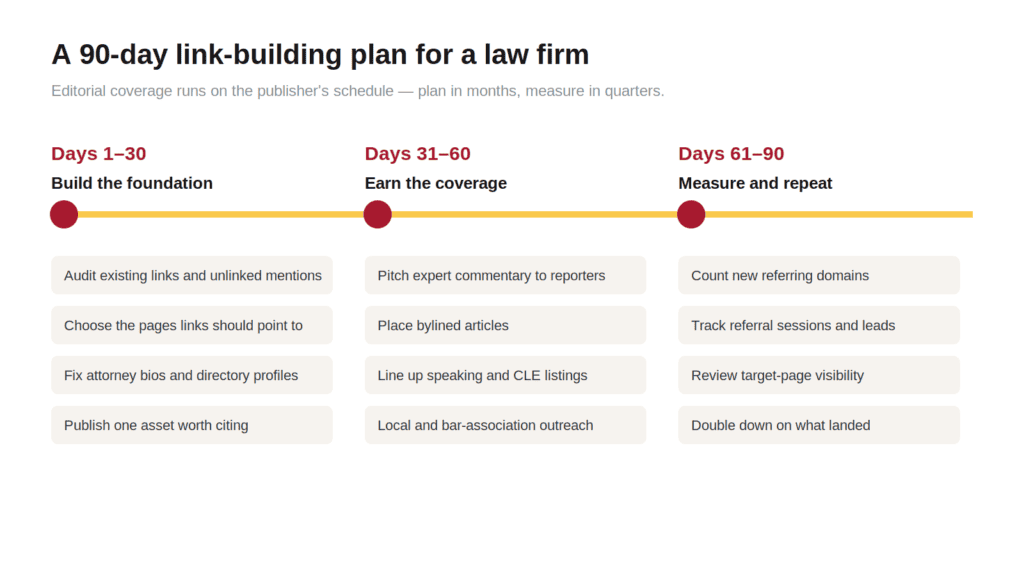
Plan in months, with quarterly reviews. The 90-day plan below organizes foundation, coverage and measurement: establish accurate profiles and useful resources, pursue relevant press opportunities, then assess the results. No provider can guarantee coverage or rankings within that period.
Use those findings to refine your broader SEO strategies. Continue opportunities that reach the right audience and reconsider work that produces activity without meaningful engagement.
What Link Building Costs a Law Firm, and How Long It Takes
There is no single useful price for link-building services. Scope depends on practice-area competition, geographic market, existing visibility and attorney participation.
An agency can handle research, outreach, content development and reporting, but attorneys still need to contribute expertise and approve communications.
For the first year, budget for recurring effort: an initial review, ongoing outreach, attorney contributions, content updates and periodic evaluation. Ask providers to explain their approach and reporting. Treat guaranteed placement counts or ranking dates with caution.
Lawyers Frequently Ask Us These Questions About Link Building
How Berbay Approaches Link Building for Law Firms
For more than 30 years, Berbay has helped law firms make their expertise visible through strategic marketing and public relations. We begin with your practice areas, prospective clients and referral audiences, then identify where credible visibility can advance those goals.
Our approach connects editorial outreach with useful content and ongoing measurement. We help attorneys contribute insight that reporters and professional audiences can use. We evaluate earned links alongside the coverage, relationships and qualified engagement they support.
We align these efforts with your law firm SEO program. Contact Berbay to discuss where your firm’s expertise could earn greater visibility and how to measure its contribution to growth.