
Online reputation management for lawyers starts with understanding how your firm appears online. Regularly review and update your firm’s website and attorney bios, legal directory listings, client reviews, media coverage and other third-party mentions to ensure information is accurate, consistent and reflects your firm’s expertise. Address outdated or inaccurate information, respond to client feedback, and build credibility through PR and media coverage. Ongoing monitoring is the core of law firm reputation management: it helps you manage how prospective clients and referral sources perceive your firm.
Your law firm’s online reputation can make or break your ability to attract new clients. The Martindale-Avvo State of the Legal Consumer Report found that 92.4% of legal consumers research their legal issue before contacting an attorney and almost 70% say reviews are the most helpful element when choosing one. The BrightLocal Local Consumer Review Survey found that 98% of consumers read online reviews for local businesses. Your digital presence can determine whether they reach out to you or not.
What Shapes a Law Firm’s Online Reputation?
Your law firm’s online reputation consists of multiple interconnected elements that collectively shape clients’ first impressions. Elements to evaluate include:
- Your website, which should clearly communicate practice areas, attorney credentials and successful outcomes, with the most essential information easy to find
- Thought leadership content like bylined articles, blogs and whitepapers
- Media mentions and press coverage
- Online reviews and testimonials across various platforms
- Speaking engagements and community involvement
- Social media presence and engagement
- Search engine visibility and rankings for relevant keywords
- Professional profiles on legal directories like FindLaw and Martindale-Hubbell, as well as your Google Business Profile
Start With an Honest Audit of Where You Stand
Knowing where your firm stands online helps you identify gaps and prioritize improvements. To evaluate your current online reputation, complete this 30-minute exercise:
- Search your firm and attorney names on major search engines, review any AI-generated summaries and ask tools such as ChatGPT and Perplexity how they describe your firm.
- Audit online legal directories for mentions of your firm and attorneys.
- Look at comments made on the firm’s social media profiles.
- Consider testimonials included on your website.
- Sort what you find into positive / neutral / needs-attention buckets.
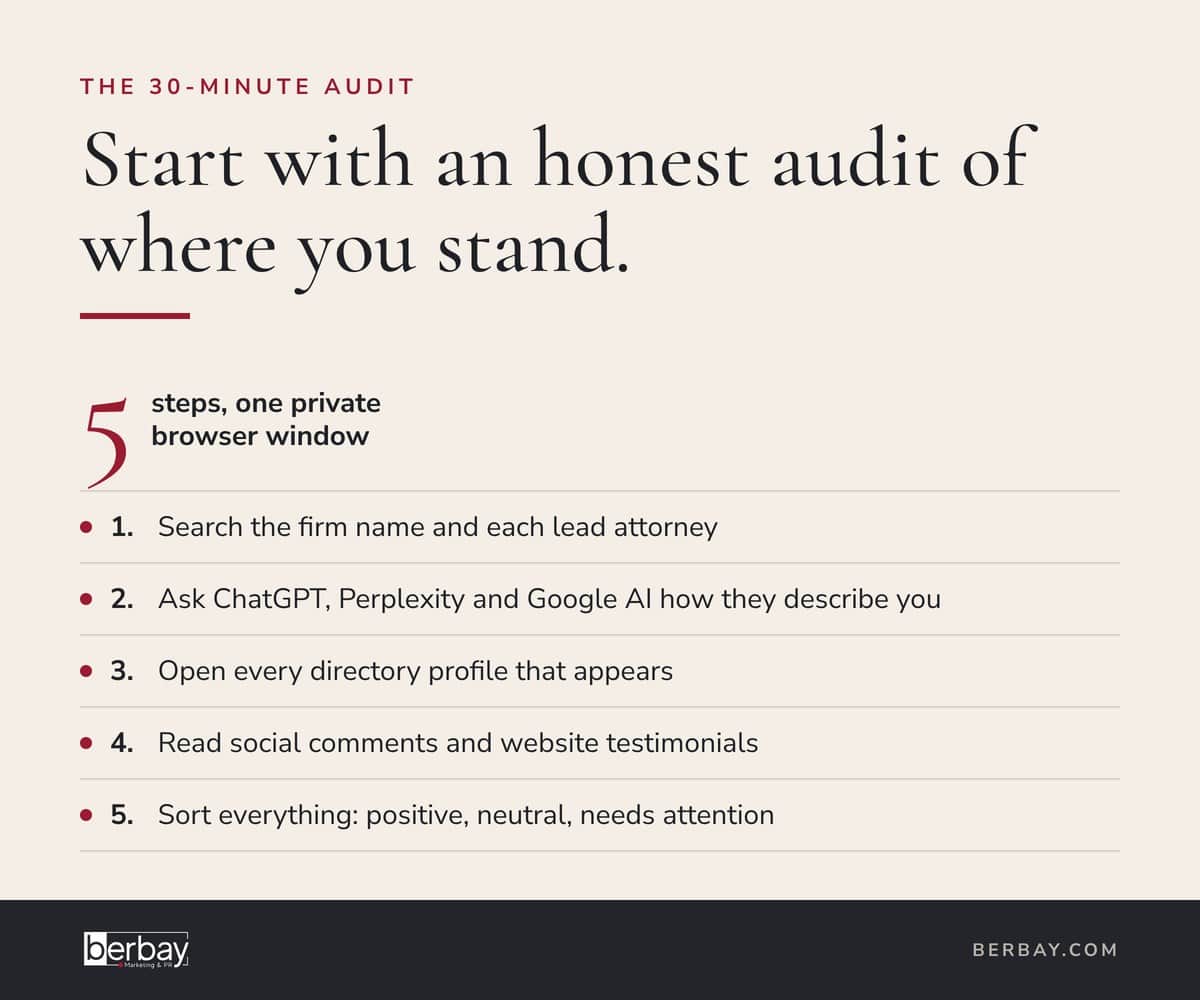
Use these findings to create a baseline reputation report that you can update to track changes over time.
Earn Client Reviews the Right Way
Client reviews are among the most influential factors in a prospective client’s decision-making process across platforms like Google, Martindale, Avvo and Facebook, and they also shape how your firm ranks in search. Reputation management for lawyers relies on obtaining reviews consistently to improve both the volume and usefulness of feedback your firm receives.
Establish a turnkey process for inviting clients and others who can speak to your work to share honest feedback. Keep requests brief, provide a direct review link and remind clients not to include confidential information. Reach out through the contact’s preferred communication channel, whether email, text message or phone, to make leaving a review straightforward.
Follow both the review platform’s terms of service and the professional-conduct and attorney advertising rules in your jurisdiction. Reviews should never be bought, incentivized or selectively gated.
Handle Negative Reviews Without Making Things Worse
Negative reviews can happen to any law firm, and how you respond can help address concerns without escalating the dispute. When you discover a negative review, respond calmly, promptly and professionally. Offer to take the conversation offline by providing direct contact information, and never argue with a reviewer publicly.
Keep confidentiality obligations in mind when replying. As discussed in the American Bar Association’s guidance on ABA Model Rule 1.6 and Formal Opinion 496, a negative review alone does not authorize disclosure of confidential information. Avoid confirming a client relationship or discussing representation details without an appropriate basis under applicable professional-conduct rules.
In some cases, it is best not to respond publicly at all. Reviews that violate platform policies can be flagged for removal. Follow Google’s process for reporting inappropriate reviews on your Google Business Profile.
Content that crosses into defamation is a matter for counsel, not a comment thread. When unfavorable coverage cannot be removed, address the underlying issue and build a fuller, current record of your firm’s work through useful content and credible third-party coverage.
Keep Your Directories and Profiles Working for You
Unclaimed or inconsistent profiles on legal directories can undermine trust when prospective clients research your firm. Attorney reputation management starts with the basics: claim and complete your Google Business Profile, Martindale-Hubbell listing and the other legal directories that matter for law firm growth, including Chambers USA and Legal 500 where applicable. Make sure attorney credentials, practice areas and awards and rankings match across every profile and your website, and that the awards you list are legitimate rather than pay-to-play.
Build the Reputation You Want with PR and Thought Leadership
Demonstrating your expertise through content your firm publishes and media coverage it earns builds credibility and strengthens search visibility. By addressing common client questions and sharing informed analysis in your practice areas, your firm can shape what prospective clients and referral sources find when they look you up.
Published content may include bylined articles, blog posts, videos, podcasts, webinars or downloadable guides. Focus on providing genuine value rather than promotional material by sharing insights about recent legal developments, explaining complex legal concepts in plain terms or offering practical guidance related to your practice areas.
Ongoing earned media coverage can build your firm’s reputation as a thought leader in your practice area. For a California law firm client, proactive media outreach around pending California legislation led to coverage in regional and national outlets, including Los Angeles Times, Sacramento Bee, Associated Press and Bloomberg Law, positioning the firm’s attorneys as go-to sources on emerging legal issues.
Monitor Your Reputation, Including What AI Says About You
Set up Google Alerts for your firm name and the names of your attorneys to track mentions across the web, and consider specialized monitoring software when online mentions or review volume justifies it. Re-run the 30-minute audit exercise on a quarterly basis to keep your firm’s reputation report current.
AI-generated answers may reference your website, directory profiles, reviews and media coverage. Check how your firm is described, review any cited sources and correct inaccuracies where possible. Lawyer reputation management now includes what AI assistants say about you, not just what Google shows.
Law Firm Reputation Management FAQs
We Help Law Firms Strengthen Their Online Reputations
For more than three decades, Berbay has helped law firms build visibility and credibility through strategic marketing and law firm public relations. We work with firm leadership to align media relations, thought leadership and communications with your business development goals.
Call (310) 405-7343 or contact us online to discuss your firm’s priorities.