

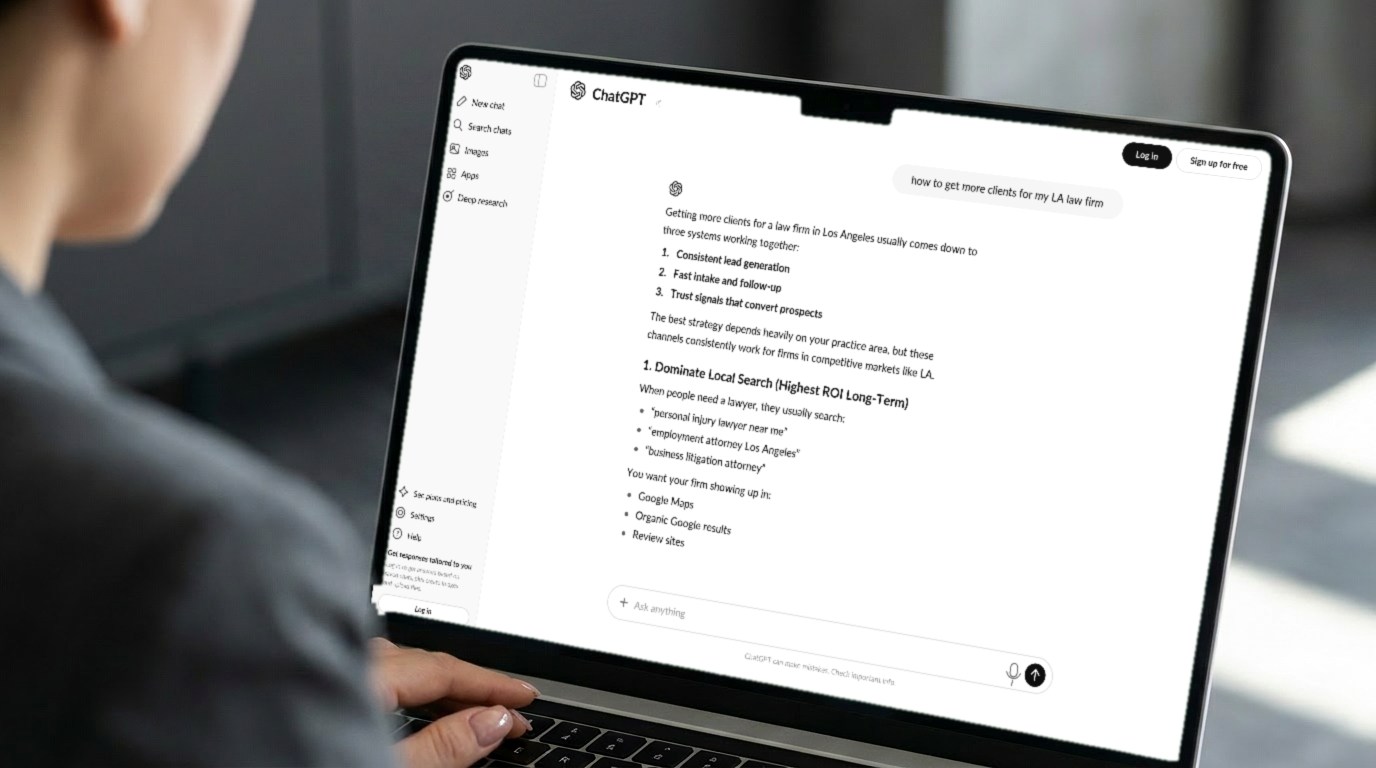
Your law firm’s website may be beautifully designed and filled with compelling content, but if potential clients can’t find you when they search for legal help, you’re missing countless opportunities to grow your practice. And how people search is no longer just a Google question — clients increasingly turn to AI tools alongside traditional search engines to find and vet attorneys. Firms that invest in law firm search optimization stay visible across both; those that don’t remain invisible to their ideal clients.
At Berbay Marketing & PR, we’ve spent decades helping law firms transform their online presence and attract more qualified clients. That work has evolved with search itself — today it spans both traditional SEO and AI search optimization. Our award-winning team understands the unique challenges legal practices face in competitive digital markets and develops customized strategies that deliver measurable results for firms nationwide.
Build a Strong Technical Foundation
Your website’s technical performance directly impacts how search engines crawl, index and rank your pages. Site speed plays a crucial role in both search rankings and user experience, as potential clients expect pages to load within seconds. Slow-loading websites not only rank lower in search results but also frustrate visitors who may leave before contacting your firm.
Mobile optimization has become essential since most people now search for legal services on their smartphones. Google prioritizes mobile-friendly websites in search results, making responsive website design for law firms a necessity rather than an option. Additionally, ensure your website uses secure HTTPS encryption, implements proper URL structures, and includes XML sitemaps to help search engines understand your site’s organization and content hierarchy.
Beyond the basics, a complete website audit covers the technical levers that quietly suppress rankings when they go unattended:
- Run a website audit with a tool like Screaming Frog to surface crawl errors, broken redirects, duplicate title tags, missing meta descriptions, and indexation issues.
- Monitor Core Web Vitals — Largest Contentful Paint, Interaction to Next Paint and Cumulative Layout Shift — which Google factors into rankings and which directly affect how long visitors stay on your site.
- Treat internal linking as one of the highest-ROI levers available. Every relevant link from one page on your site to another helps search engines understand your topical authority and helps prospective clients navigate to the information they need.
- Pair pillar pages with deep cluster content so your topical authority is structurally visible to both Google and AI engines.
- Get your content layout right — clear headings, scannable structure, descriptive title tags and properly implemented schema markup support both search engines and human readers.
Develop Strategic Content and Target the Right Keywords
Effective keyword research forms the backbone of successful law firm SEO, but many practices make the mistake of targeting overly broad or competitive terms. Instead of competing for generic phrases like “lawyer,” focus on specific practice areas combined with your location, such as “estate planning attorney Denver” or “personal injury lawyer Miami.” These targeted keywords attract people with clear legal needs who are more likely to become clients.

Content strategy should center on answering the specific questions your potential clients ask rather than creating generic legal information. Develop comprehensive guides addressing real client concerns, publish regular blog posts about recent legal developments affecting your practice areas, and create resource pages that establish your firm as a trusted authority. This approach not only improves search rankings but also demonstrates your knowledge and builds trust with potential clients before they contact you.
Strong content strategy goes deeper than keyword targeting. Organize related posts into topic clusters that link back to a pillar page, so search engines and AI engines alike can identify your firm as a comprehensive resource on a given practice area. Map every piece of content to a clear user intent — what is the client actually trying to learn, decide, or accomplish — and write to that intent rather than to a keyword density target. The on-page content optimization tools that scored law firm websites reliably in 2022 are less effective today; AI-powered search engines reward semantic completeness, accurate citations, and demonstrated expertise more than they reward keyword frequency. For a deeper look at the research side, see our guide to keyword research for law firms.
Master Local SEO and Online Presence Management
Local search optimization is particularly critical for law firms since most clients prefer working with attorneys in their geographic area. Your Google Business Profile serves as a digital storefront that appears in local search results and Google Maps, making complete optimization essential for attracting nearby clients. Ensure your profile includes accurate contact information, professional photos, detailed service descriptions and regular updates about your firm’s activities.
Online reviews significantly impact both local search rankings and potential clients’ decision-making processes. The following strategies help you build a strong review foundation while maintaining ethical standards:
- Develop a systematic approach for requesting reviews from satisfied clients at case completion
- Respond professionally to all reviews, both positive and negative, showing you value client feedback
- Monitor your online reputation across multiple platforms including Google, Yelp and legal-specific directories
- Address any negative feedback promptly and professionally to demonstrate your commitment to client satisfaction
These review management practices not only improve your search visibility but also build credibility with potential clients researching your firm online.
Local listings beyond Google Business Profile matter too. Build a consistent presence across legal directories — see our guide to legal directories for law firms — and pair that with a deliberate approach to attorney reviews and SEO so the off-site signals reinforce what’s happening on your site.
AI Search Optimization: Getting Found Beyond Google
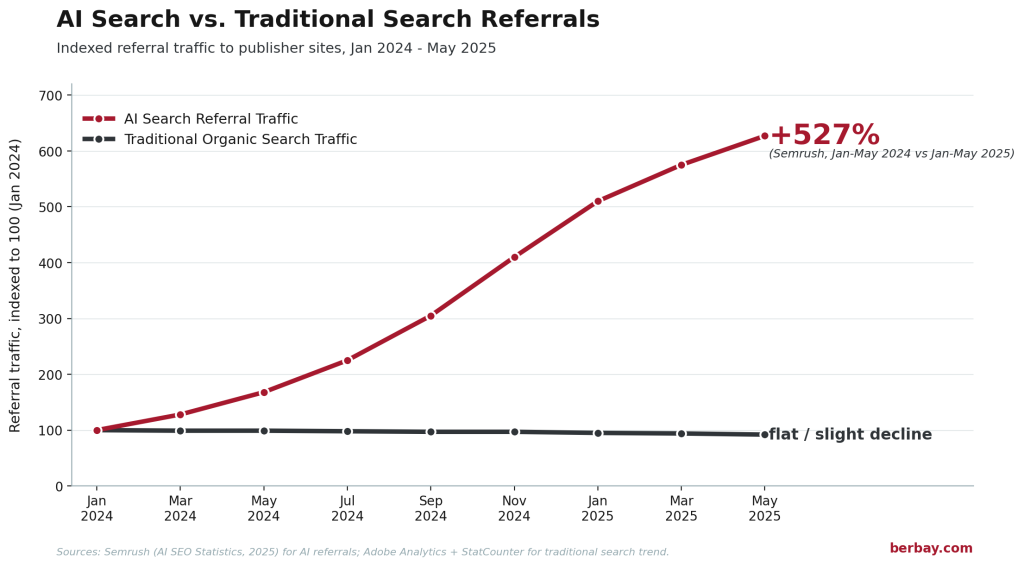
Search is fragmenting. Google still holds 89.66% of global search market share as of April 2025 — but that figure marks a measurable break from the 90%-plus floor Google held for the previous decade (Statista). Meanwhile, AI search traffic from ChatGPT, Perplexity and Microsoft Copilot rose 527% year-over-year between early 2024 and early 2025, with some sites now sourcing more than 1% of total sessions from these LLM platforms (Semrush). The broader competitive picture matters too: Meta is on pace to surpass Google in digital ad revenues for the first time ever (eMarketer), and analyst research on the global search engine market confirms that user attention is diversifying across new entrants. For law firms, the implication is direct — ranking on Google alone is no longer the whole goal.
How search behavior is changing
Potential clients increasingly ask ChatGPT, Google’s Gemini, Perplexity and Microsoft Copilot the same questions they used to type into Google: “best estate planning attorney in Chicago,” “how does mediation work in California,” “what does a personal injury case cost.” Instead of returning ten blue links, AI-powered search engines return one synthesized answer with a short list of cited sources. For a law firm, the new question isn’t only “do we rank?” — it’s also “are we one of the cited sources when an AI answers a question about our practice area?”
What AI Search Optimization actually requires
The discipline goes by several names — AI Search Optimization, Answer Engine Optimization (AEO), Generative Engine Optimization (GEO), and Large Language Model Optimization (LLM Optimization) — but the core requirements overlap:
- Structured, scannable content with clear definitional passages an AI can extract.
- Strong E-E-A-T signals — Experience, Expertise, Authoritativeness, Trust — anchored by real author bylines, verifiable credentials, and citations of authoritative sources (we go deeper on this in our E-E-A-T and YMYL guide for lawyers).
- Schema markup that helps search engines and LLMs interpret your content.
- A robust off-site footprint — PR mentions, legal directory listings, social proof and earned media. The relationship between PR and SEO is more symbiotic than ever in an AI-driven search landscape.
- Backlinks still matter. Both Google’s ranking systems and the training data behind major LLMs weight authoritative inbound links — they remain a meaningful trust signal, not a relic of 2015 SEO.
- A coherent social media strategy. AI engines surface and cite content from established social presences, and a steady drumbeat of professional posts reinforces your firm’s authority.
Train AI about your firm by using AI in your firm
One of the most overlooked levers in AI search optimization is direct hands-on experience. Firms that use AI tools in their workflow — research, drafting, intake triage, content production — develop firsthand intuition for how these engines reason, what content they cite, and how to structure expertise so it surfaces. Tools like the Claude SEO Skill apply Claude directly to SEO work, which produces two compounding benefits: better optimization output, and a working understanding of how AI parses and credits your firm.
Content optimization tools are less reliable than they used to be
On-page scoring tools that worked reliably in 2022 give diminishing returns today. Keyword density and topic-cluster scoring still surface useful signals, but AI engines reward semantic completeness, accurate citations, and demonstrated experience more than they reward hitting a numeric content score. The goal isn’t to be the page that scored highest — it’s to be the most useful, accurate, well-sourced answer on the topic.
Measure Performance and Continuously Optimize
Search engine optimization requires ongoing monitoring and adjustment to maintain and improve your rankings over time. Google Analytics and Google Search Console provide valuable insights into how people find and interact with your website, helping you identify which pages perform well and where improvements are needed. Track key metrics like organic traffic growth, keyword rankings and conversion rates to measure your SEO success accurately.
Regular content updates and website maintenance signal to search engines your site remains active and relevant. Schedule periodic reviews of your existing content to ensure information stays current, add new pages addressing emerging legal topics in your practice areas and optimize underperforming pages based on search data. This continuous improvement approach helps you stay ahead of competitors and adapt to changing search engine algorithms that could impact your visibility.
Common Questions About Law Firm Search Optimization
Ready to Modernize Your Law Firm’s Search Strategy?
Law firm search optimization in 2026 spans technical SEO, content strategy, local visibility, off-site signals, and increasingly, AI search citations. Few firms have the time or specialized expertise to maintain all of it internally.
Berbay has spent more than three decades helping professional services firms turn expertise into visibility and credibility. We act as an extension of your team, with transparent reporting and the strategic judgment that comes from working exclusively in professional services since 1995.
Call (310) 405-7343 or reach us through our contact form to talk through what this looks like for your practice.