


To get ranked in Chambers and Partners, first you need to prepare and submit a nomination in your practice area and jurisdiction with up to 20 matters and up to 30 client referees (in the U.S.). Chambers researchers then review your submission, interview referees and gather market feedback. Rankings publish the following year. Submitting is free, but a strong submission takes months of preparation.
So, you put a lot of work into your Chambers nomination and then the rankings publish and you’re disappointed in the outcome. What can you do to get a better result next time?
Having decades of experience submitting nominations and getting firms listed, we’re sharing our pointers for how to get ranked in Chambers and Partners, or obtain a higher ranking.
Who Does Chambers and Partners Consider for Rankings?
Lists and rankings of law firms have become ubiquitous, with some being more credible and sought-after than others. Chambers is a legal ranking guide developed to assess lawyers and law firms worldwide, covering more than 200 jurisdictions. Many consider Chambers the leading directory in the legal profession and one of the toughest lists to get on because they have built a reputation for their high degree of selectivity with only 2% of U.S. law firms getting ranked, and you cannot buy your way in.
Currently, the lawyer ranking guides are by geographical area with well over one hundred different practice areas. Chambers often adds practice areas as industries grow or new niche areas crop up.
While Chambers does not rank based on firm size, it has made a much stronger push to accommodate smaller firms in recent years, including publishing Spotlight Guides for small and medium-sized law firms in Illinois, Ohio, Texas, North Carolina, New York, Florida and California.
Chambers ranks both firms and individual lawyers in bands from 1 (highest) to 7 (lowest), although being recognized in any band is an achievement. Associates are considered for rankings including: Up-and-Coming, Star Associate and Associate-to-Watch.
How the Chambers Submission Process Works
Submitting for a rankings consideration in Chambers is free and submission deadlines are staggered by jurisdictions and practice areas. You can submit online at the Chambers website where there are submissions forms to download along with your referee spreadsheet.
Once your submission is received and the respective research period opens, editors conduct research and interview your referees. Chambers USA rankings typically publish in June each year.
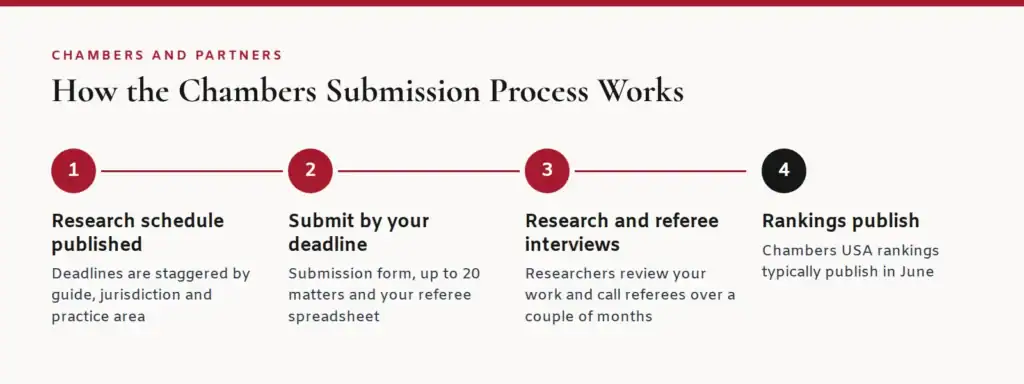
The following table further explains the process.
|
What you submit |
What to include |
Where it goes |
|---|---|---|
|
Firm or department overview |
Firm contact information |
Submission form |
|
Matters / work highlights |
Up to 20 – this can be a mix of publishable and confidential |
Submission form, one per page |
|
Attorneys to put forward for ranking |
Key partners and rising associates |
Submission form B6 section |
|
Client referees |
Up to 30 for Chambers USA |
Separate referee Excel spreadsheet |
|
Narrative section |
Up to ~500 words |
Submission form B7 section |
|
Cost to submit |
Free |
— |
Tips to Keep in Mind
When submitting, focus on getting a state ranking before you pursue a nationwide one. Even if you have a national practice, securing a national ranking is rare if your firm hasn’t been ranked regionally (meaning wherever your offices are located).
If your firm has a regional ranking and it truly has a national presence, go after the national ranking right away; don’t wait a few years to submit.
If you are submitting for both regional and national, do not copy/paste. You need to differentiate your capabilities. For state submissions, demonstrate your local market knowledge and strengths in the region. For national submissions, highlight your presence and successes across the U.S.
Chambers is one of the most extensive nominations. It asks for great detail, and you’ll likely need to coordinate with multiple lawyers to get the requested information. Rushing through a nomination or starting a couple of weeks before the deadline usually results in a below-average submission. Start at least three months before the submission deadline so you can do justice to your nomination.
Berbay spends around 40 – 60 hours per submission, so you’re looking at up to 180 hours if you work on three submissions! If you’re submitting for the first year, allow for even more time.
Choosing Your Matters for a Chambers Submission

Choosing the matters you submit is crucial to success. Focus on matters that made a real difference for the client or industry, involve novel or significant issues, or demonstrate the depth and value of the team’s work. Quantify the specific outcomes whenever possible rather than providing a rote description of the matter.
While Chambers allows up to 20 matters, quality is more important than quantity. It is better to submit 15 strong, impactful matters than to fill all 20 slots with matters that add little to the overall submission.
Matters can be designated as publishable or confidential. If there is any sensitivity around publishing the client’s name or details of the work, use the confidential section. Chambers does not penalize firms for including confidential matters. It’s better to include a confidential matter with a detailed description that tells the full story, including the significance and outcome, than to water down a strong matter simply to make it publishable.
Confidential matters are used only for Chambers’ internal analysis and research and are not published. They are maintained in Chambers’ secure database and are accessible only to Chambers research staff.
Who You Should Submit for a Ranking
When it comes to which lawyers you should submit, here are some thoughts to consider. Any lawyer – partners and associates – can be nominated; however, not everyone warrants inclusion. Who you submit should be driven by the matters you plan to submit and your ranking objectives for Chambers. If you don’t have any lawyers ranked currently, or only one or two, it’s unlikely Chambers will rank 20 in the next guide. Focus on key practice area partners and other lawyers with significant activity in the past 12 months.
If, because of internal considerations, you need to nominate someone who is not putting forward matters or does not have a significant body of work, you can use the lawyer bio and B7 practice overview to strengthen their profile. These sections provide an opportunity to explain what the lawyer has accomplished over the past year and highlight what may be of interest to Chambers researchers.
For example, a litigator may have a dozen active matters but nothing that has resolved during the submission period. In that case, use the bio and B7 to highlight the ongoing matters, notable clients, significant issues being addressed and any unique expertise that demonstrates the lawyer’s activity and value to the practice.
How to Choose and Prepare Your Chambers References
“Referees” is the term Chambers uses for references – clients, peers or others who can speak to the caliber of your work. One of the most heavily weighted aspects of Chambers’ research is talking to referees, so it’s important to submit names who will be responsive to Chambers. While it’s great to name the general counsel of a Fortune 500 company as your referee, if they are not responsive, consider a second or third in command if they are more available. You can submit 30 referees for Chambers USA so ideally, you should put forth the maximum number.
Referees can be a sticking point for lawyers who don’t want to bug their clients year after year. Some law firm clients won’t participate due to the confidential nature of their legal matters. Given the many hurdles when deciding who to list, you may need to get creative – consider listing older clients who are familiar with the Chambers process, co-counsel or even opposing counsel you’re friendly with.
Ensure that referees know Chambers will contact them. Referees often ignore emails from Chambers because they think it’s spam or miss their email because they are unaware it’s coming. If you submit someone’s name, you must prepare them for the process. For example:
- Let them know that you’re submitting their name (this can be done if you get their approval first).
- Explain that a Chambers researcher will email them to set up a phone call or respond to an online questionnaire.
- Give them the name of the researcher who will contact them, but ask them to be on the lookout from any “@chambers.com” email address to ensure nothing gets overlooked.
- Explain what questions the researcher might ask (here is a brief overview).
- Explain to your referees that it will take very little of their time. Whether they have a phone conversation or fill out the questionnaire, it should only take 5 to 10 minutes.
You want to prepare referees as much as possible. In addition to giving them questions in advance, offer to help them hone their communication points.
Writing the Narrative Section
The B7 section is where you describe why your firm and lawyers should be ranked. Often, firms will include generic descriptions of their practice area from their website, repeat the matters they’ve already outlined in the matter section, or not spend enough time on this section entirely, but this is the only part of the nomination that gives you the ability to sell yourself.
Chambers wants substantive information, not marketing fluff. For example, quantify the amount of work you’ve done over the years (e.g., you’ve worked on more than $4 billion in deal transactions, or you’ve secured close to $100 million in verdicts and settlements), along with highlighting the lawyers that you want to get listed. This is the kind of information Chambers looks for when considering firms and lawyers to rank.
Don’t forget to put yourself in the shoes of the researcher reading thousands of submissions. Keep their attention! Describe the significance of your work. Why was it important? What was the outcome and what impact did it have? Don’t just describe the day-to-day work. Think about telling a story beyond providing a basic description.
Also, don’t change the form in any way. Chambers hates when firms do this.
After You Submit
Chambers has 320+ editors and researchers. Every researcher is assigned to a different practice area, so they’re not always the same year after year. Researchers are the ones conducting the interviews with your referees, obtaining market feedback and reviewing your submission. The research process usually takes a couple of months.
You can find information on which researcher is assigned to what practice area and research schedules on the Chambers website. In our experience, researchers appreciate it if you reach out to them to introduce yourself and offer to help them through the process. This can also be helpful if your referees are having any issues receiving emails and you need to connect them with the researcher directly.
Chambers has rolled out several paid tools to assist with the submission and feedback process. These are not required, but they may be helpful if you are consistently submitting and not getting ranked, or if you are looking for more insight into how Chambers views your practice and competitors.
The Chambers Client & Market Intelligence Report (formerly Insight Report) is available for purchase and provides data and analysis on your firm’s rankings and market feedback. It can provide insight into your competitors, why they are ranked, client feedback, market trends and areas for improvement, as well as guidance for future submissions.
If you are struggling to obtain a ranking or move up in bands despite consistently submitting, it may be worth purchasing the report for a year to see whether the additional information helps inform your submission strategy.
Even though researchers often change every year, one of the ways you can keep in front of them is through the editorial staff (a list of all their editorial staff). It’s always a good idea to keep them apprised of what’s going on, whether it’s newsworthy or something you want them to note, so you’re not coming in cold during the research process.
There is no exact formula for getting ranked, and we often see inflated expectations. Don’t expect Chambers to rank five new attorneys in one year. Like most things, it takes work and time.
How to Leverage a Chambers Ranking
You’ve gone through this entire process. It’s extensive. It takes a lot of time. So why submit?
One important consideration is that Chambers is one way to level the playing field. If you’re a small firm stacked against larger firms and get ranked, you can use it for marketing purposes – put it on your website and lawyer bios, in proposals and capabilities, promote on social media, etc. There’s a lot of mileage that you can get out of the ranking.
Whether Chambers is worth the effort is another question. Read more about who is using legal directories to vet and hire law firms.
Get Help With Your Chambers Submission
Berbay Marketing & PR manages nominations and the full Chambers submission process. We have over three decades of experience providing law firms with marketing and public relations services that propel your business forward.