


There are numerous ways firms can choose to market their legal services. Of the many options, it’s no secret that content marketing is one of the more resource-intensive approaches. A successful content strategy requires buy-in from managing partners and senior lawyers, and consistent effort to create blog posts, bylined articles, client alerts, webinars, email newsletters, podcasts and other earned and owned media.
Does investing this much time and effort truly pay off?
The answer is yes, content marketing for law firms works – when done strategically. By creating valuable, informative content that addresses prospective clients’ questions, law firms establish credibility, build trust and generate qualified leads without the hard sell of traditional advertising. An effective content program is measurable and delivers results, just like any other marketing tactic. And perhaps more than any other approach, the initial investment pays off over time, as content can be repurposed repeatedly across multiple platforms such as your website, social media and email marketing.
What Content Marketing for Lawyers Actually Is
Put simply, content marketing is sharing useful, relevant information to build credibility and keep your firm top of mind among your clients, prospects and referral sources. It can involve both owned channels, like your firm’s blog or social media profiles, as well as earned channels, like legal publications where you can publish bylined articles. However, the approach is often misunderstood and conflated with other marketing activities.
An effective program isn’t just sending an email newsletter once a year or posting on LinkedIn sporadically. To be effective, it must be backed by a content strategy that outlines when, where, why, how and to whom content will be shared. It must also be measurable. A well-designed campaign allows you to track progress, make improvements and ensure your investment is paying off.
This approach is also different from advertising. Rather than making a direct appeal to consumers via a billboard, magazine ad or TV commercial, content marketing provides educational value and demonstrates your expertise. Then, when a potential client has a legal need, they either already know and trust your firm, or they can quickly vet your experience. While advertising increases brand recognition, it typically does very little to establish trust with potential clients. This is where educational publishing shines.
A content program is also much more than your law firm blog. While a blog can play an important role, it’s one of many platforms that can (and should) be used. A blog alone will not reach clients across the entire decision-making process. Depending on your practice area and marketing goals, a blog may not even be an appropriate way to reach your target audience. This is why an editorial strategy is essential: it helps you determine which channels and approaches actually work for your firm.
Why Content Marketing Works for Law Firms
This approach works particularly well for legal services because clients usually conduct extensive buyer research before making attorney hiring decisions. According to Martindale-Avvo, current buyer behavior revolves heavily around digital presence. The average legal consumer uses multiple forms of online research, and contacts two to three law firms before choosing one. Potential clients are checking your website, social media profiles and recent media coverage before even reaching out for a consultation. This is why content marketing is a powerful tool for lead generation: it helps you make the best possible first impression and guides prospects to become clients.
SEO has also shifted toward promoting authoritative content. Today’s sophisticated search algorithms don’t just use keywords to determine which websites to put at the top of the search engine results page. Instead, they look at overall reputation. For example, Google uses the Experience, Expertise, Authoritativeness and Trustworthiness (E-E-A-T) framework to evaluate web content. If SEO is an important part of your firm’s marketing strategy (and it should be), your publishing program needs to support it, too.
A Legal Content Strategy That Compounds
A legal content strategy includes multiple components that build off each other. When each element works together, you see stronger results. What does that look like in practice?
First, identify the target audience you want to reach. This could include referral sources, existing clients or ideal clients. What are they reading, watching and listening to? Which conferences are they attending? What legal needs do they have? This knowledge lays the foundation for the rest of your content strategy.
Next, map your “funnel,” or the interactions potential clients have with your firm before they hire you. Typically, clients start at the top of the funnel with general content like practice area pages, attorney bios and blogs. As they become more interested in your services, they work their way down to more in-depth content.
An editorial calendar can shape what topics you focus on throughout the year. It should include evergreen topics as well as timely developments you can comment on, such as legislative changes that could impact your clients. Seasonality is also important. For example, an insurance bad faith law firm might see an uptick in interest during hurricane season. Content efforts can be tailored to reflect these seasonal changes.
Of course, none of this effort matters without distribution. How will you share your content for maximum exposure and engagement? A distribution strategy can include a mix of owned media (like your email newsletter), earned media (such as public relations tactics) and paid media (like social media ads). SEO also makes your content more visible. By optimizing your content with keywords and other tactics, your website shows up higher on the search engine results page and in AI platforms, with the latter increasingly being used as a starting point for prospects researching law firms.
Once content planning is done, workflow is what makes or breaks a campaign. Someone, whether that’s a partner, an in-house marketing director or your PR agency, needs to confirm that content is well crafted, distributed correctly and in line with content pillars. Oversight ensures that content remains consistent and the strategy is effective.
Measurement is the final piece of the puzzle. Tracking KPIs helps you determine whether your content strategy is working. If you’re not seeing the results you want, measurement helps pinpoint which of these elements needs to be tweaked.
Content Types That Earn Attention
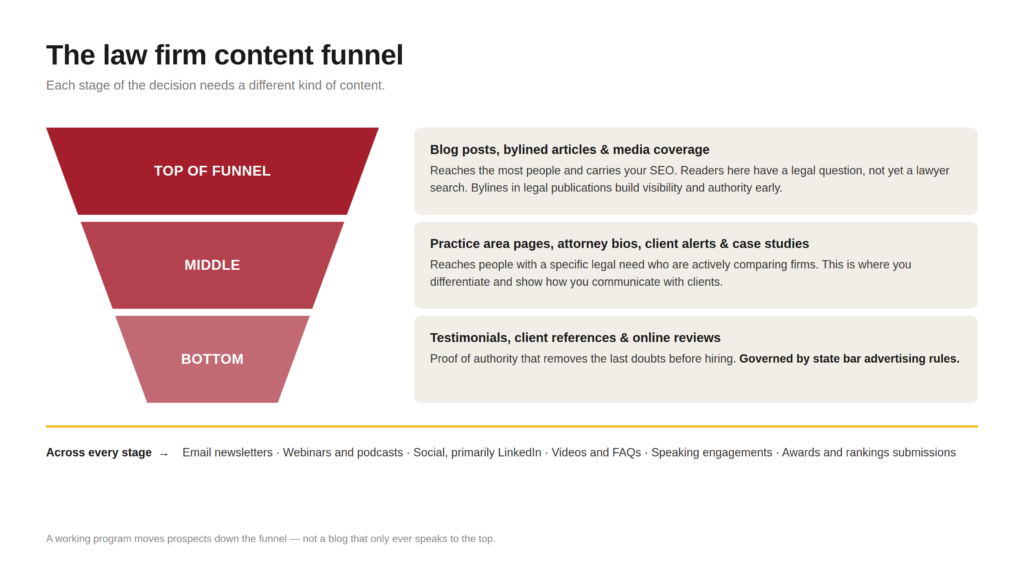
A well-rounded program supports prospective clients at every stage, from initial awareness through the final hiring decision. The formats that work best change as prospects move closer to choosing a firm.
Top of the Funnel
Content at the top of the funnel reaches the greatest number of people. Anyone who is interested in a general legal topic might come across it, but that doesn’t mean they are actively searching for an attorney. Still, this content is crucial because it serves as a key part of your SEO efforts and improves your overall digital presence.
- Media coverage
- Bylined articles
- Blog posts
- Webinars and podcasts
- Social content
- Speaking engagements and panels
- Rankings and awards submissions
- FAQs
- Videos
Middle of the Funnel
The middle of the funnel reaches people who have a specific legal need and are actively searching for a firm. This content differentiates you from other firms and demonstrates your expertise. Importantly, it also serves as an example of how you communicate with clients.
- Practice area pages
- Attorney bios
- Client alerts
- Case studies
Bottom of the Funnel
The bottom of the funnel is where qualified leads transition into clients. Content at this stage serves as evidence of your authority and removes any lingering doubts about your firm.
- Testimonials
- Client references
- Online reviews
Testimonials, client references, online reviews, case results and claims of specialization may be subject to state bar advertising rules. Review the applicable jurisdiction’s requirements before publishing.
A strong editorial program includes a mix of activities that guide leads from the top to the bottom of the funnel. A blog or email newsletter alone may capture some clients, but real business impact happens when content is integrated into a larger, measurable strategy.
Ethics Considerations Across States
Like all marketing activity, law firm content marketing is governed by attorney advertising guidelines. To remain in compliance with ethics rules, content must be truthful and not misleading, particularly when describing your services, credentials and case results. However, there are nuances at the state bar level. Some examples include:
- In New York, communication that is intended to encourage a specific group of recipients to retain your firm must meet both Rule 7.1, which governs attorney advertisements, and Rule 7.3, which governs solicitations.
- The California State Bar Association states that a blog that is a part of an attorney’s or law firm’s professional website will be subject to the rules regulating attorney advertising.
- In Florida, testimonials can only be used for marketing purposes if they are written by clients about their actual experience. Attorneys cannot write or edit testimonials in any way, nor can they compensate clients for reviews.
- Illinois does not recognize legal specialties and prohibits attorneys from claiming they are “experts” or “specialists” in a particular practice area.
Additional rules vary by jurisdiction, so check with your local bar association to ensure your content marketing tactics align with Rules of Professional Conduct.
How to Measure What’s Working
Content marketing shouldn’t be a gamble. When done properly and measured, a campaign will demonstrate a clear return on investment.
Implementing a measurement system allows you to refine your content strategy based on performance data rather than assumptions. Focus on KPIs that demonstrate genuine business impact. Some examples include:
- Organic traffic to practice area content: Demonstrates that potential clients are seeking out your information and search engines deem your content valuable.
- Non-branded keyword rankings: Reveals your visibility in comparison to competing firms.
- Newsletter open and click rates: Helps you identify which subject lines and topics are interesting to readers.
- Consultation requests attributable to content: Shows which types of content are sealing the deal for clients.
- Assisted conversions in Google Analytics 4 (GA4): Demonstrates which top- and middle-of-the-funnel content clients saw before hiring you.
- Source-of-business tracking in CRM: Helps you track where leads originate and which marketing activities are generating the most revenue.
- Topic-level conversion rates: Shows which content topics your target audience finds most valuable.
Common Mistakes That Stall Law Firm Content Marketing
Content marketing often fails not because there is no plan or someone designated to lead the charge. These are some of the biggest pitfalls we see time and again.
- Publishing without distribution. If a post is published on a law firm blog and no one is around to read it, does it make an impact? Your strategy must include a plan to get content in front of the right audience, whether that’s through social media, email or another channel. There is little point in investing time to create content if no one is going to see it.
- No editorial governance. Cohesive content marketing doesn’t happen without leadership. Every piece of content, from podcast episodes to attorney bylines, should be in service of larger marketing goals. Without someone overseeing the editorial calendar, workflows and attorney engagement, a content marketing campaign will quickly fizzle out.
- Not writing for your audience. Some prospective clients look for in-depth information on case law and legislative updates, while others simply want proof they’re hiring an attorney with experience. In either case, how you write for your audience, even more than the topics you write about, demonstrates that you are sensitive to prospective clients’ needs and will communicate with them in an understandable way.
Getting Help When You Need It
Content marketing is an impactful marketing strategy you can leverage no matter your firm size, resources or budget, even if you don’t have an outside law firm marketing agency. It can be adapted to meet your business goals and integrate with your existing marketing strategy. A successful campaign is even more attainable if attorneys are willing to contribute to development of content. When that’s not possible, a content marketing agency for law firms can assist with creating an editorial calendar, distribution strategy, integrating SEO, and ensuring that your content is in line with ethics rules.
If you’re looking for support for your marketing and public relations efforts, contact us at (310) 405-7343 or info@berbay.com to learn about our services.